



Bonnes pratiques en métrologie 3D et en machine MMT (CMM)
- Introduction to CMM fundamentals and the role of metrology in precision measurements
- practices for interpreting technical drawings to ensure accurate CMM measurements
- Measurement strategies using a CMM, covering setup, alignment, and scanning procedures
- Calculation algorithms, including best-fit methods and practical tips for reliable results
- Accurate measurements with handheld CMMs: techniques and best practice guidelines
- Preparing comprehensive measurement reports with clarity, accuracy, and reproducibility
- Understanding measurement uncertainties and strategies to minimize errors in practice
- Exercises, synthesis, and workshop activities to reinforce CMM fundamentals and best practices
This training covers the selection of the number of measurement points when using Co-ordinate Measuring Machines (CMMs) and gives advice on the compromise between accuracy and speed. It provides guidance on sampling criteria for standard features and advice on measurements that involve projections of features over long distances. It covers cleanliness, part loading/alignment and the effect of temperature, surface finish and geometry on the result. It also contains information on basic measurement principles, common measurement requirements, CMM software functionality in relation to drawing requirements and good metrology practice when using CMMs with CAD to inspect parts.
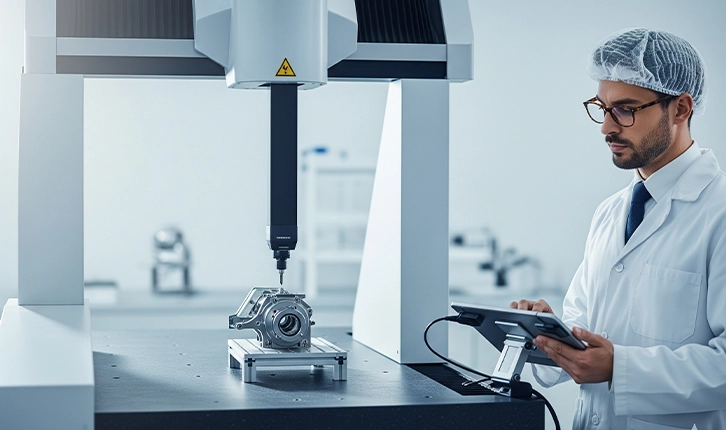
The training goal of this module is to familiarize the participants with good dimensional and shape measurement practices based on the ASME Y14.5 standard, using three-dimensional measuring devices (CMM and portable CMM). The training provides guidance on sampling criteria for different types of geometries, in addition to advising on measurements involving projections. It covers cleanliness, loading/alignment of parts, the effect of temperature, surface condition and geometry on the final result. It also contains information on measurement principles, common measurement requirements, functionality of CMM software versus drawing requirements, and good metrology practices when using CMMs with CAD data to inspect parts. At the end the trainee will also be able to make sound judgements on selection of stylus, machine force, and strategies, to minimize the measurement uncertainty value and to help the machine perform at its highest caliber.
Metrology technicians, quality inspectors, production engineers.
CMM types and operation, programming fundamentals, stylus and force selection, measurement strategies, result interpretation, error management.
Theory, hands-on practice on CMM, data analysis.
Precision part inspection, quality control optimization, reporting.
CMM Measurement Fundamentals