



Basic training on surface roughness
- introduction, the importance of surface roughness, instruments
- Filtering surface textures into roughness, waviness, and form for accurate characterization
- Surface roughness parameters and standards: ISO 1302 and ASME 14.36 for specification
- Amplitude, spatial, hybrid, functional, and 3D texture parameters explained in detail
- Selecting optimal parameters based on different applications and functional requirements
- Exercises to practice surface roughness analysis and parameter selection techniques
Surface finish is the term used to describe the texture of a surface, and it is sometimes used interchangeably with the term surface texture. Requirements for surface finish are frequently found on technical drawings for mechanical parts, particularly where parts fit together tightly, move against each other, or form a seal. Measuring surface texture, and analyzing it accurately, provides vital information as to how a component will perform its intended function—as it leaves the factory and throughout its lifespan.
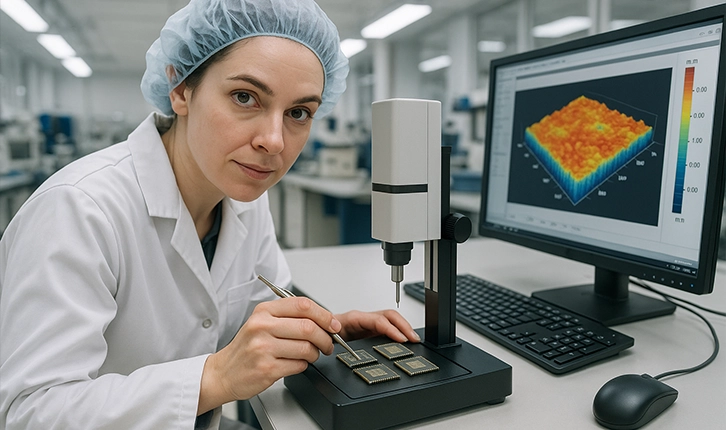
This module introduces many common and advanced surface texture parameters, starting with basic amplitude parameters such Ra, and Rq, and moving on into spatial parameters, hybrid parameters and functional parameters. We look at the definition and meaning of each parameter, as well as their strengths and shortcomings for describing how a part will fulfill its function. Most important, we show which parameters are best suited for use in common applications.
At the end of this training, the participants should be able to Master the basics of surface texture/surface roughness, apply filters and surface texture parameters to analyze surface roughness measurements and choose the appropriate measuring instrument ranging from 2D stylus systems to 3D systems such as optical profilers and confocal microscopes.
Quality control operators, metrology technicians, industrial design engineers
Amplitude parameters (Ra, Rq), spatial, hybrid and functional parameters, instrument selection (2D stylus, optical profiler, confocal microscope)
Theory-based training with hands-on examples and data analysis
Surface inspection in aerospace, automotive, medical and tooling industries
Metal 3D printing
technologies